



Why the Design-to-Delivery Process Determines Product Success
Taking a product from an initial idea through to full production is one of the most critical stages in manufacturing. Decisions made early in the design phase directly affect tooling cost, part quality, production efficiency and long-term reliability.
At Stephens Plastic Mouldings, we specialise in managing the entire design-to-delivery journey for plastic injection moulded components. By integrating design support, prototyping, tooling, manufacturing and quality assurance, we help customers reduce risk, control costs and bring products to market with confidence.
This end-to-end approach ensures that every stage of the journey is engineered for manufacturability, efficiency and consistent quality.
Phase 1: Concept Development and Design for Manufacture
Turning Ideas into Manufacturable Designs
Every successful moulded component starts with a clear understanding of function, environment and performance requirements. During the early design stage, our engineers work closely with customers to understand:
- Product intent and application.
- Mechanical and environmental demands.
- Volume expectations and lifecycle requirements.
- Cost and timing constraints.
This collaborative approach ensures that creativity is balanced with commercial reality.
Design Precision and Manufacturability
Using advanced CAD and modelling tools, designs are refined with design for manufacture (DFM) principles in mind. This includes:
- Optimising wall thickness and geometry.
- Ensuring correct draft angles.
- Reducing unnecessary complexity.
- Planning for efficient tooling and mould flow.
Designing correctly at this stage significantly reduces tooling changes and production delays later.
Phase 2: Prototyping and Design Validation
Rapid Prototyping for Real-World Testing
Prototyping transforms design intent into physical reality. At Stephens Plastic Mouldings, rapid prototyping is used to:
- Validate fit and assembly.
- Test functionality and performance.
- Assess material suitability.
- Identify potential manufacturing challenges early.
By testing prototypes before committing to full tooling, customers avoid costly rework and gain confidence in their final design.
Phase 3: Tooling and Injection Moulding Preparation
Tooling Built for Performance and Longevity
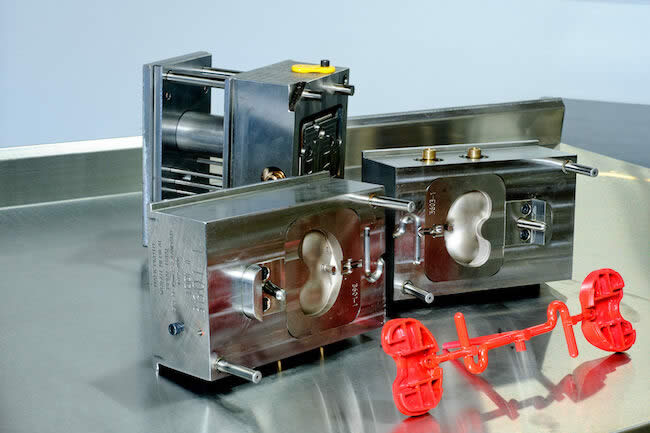
Tooling is one of the most significant investments in injection moulding. Our tooling strategy focuses on:
- Accuracy and repeatability.
- Efficient cycle times.
- Long-term durability.
- Scalability for future production.
Whether using aluminium, steel or hybrid tooling solutions, every mould is engineered to support consistent quality and predictable production.
Phase 4: Manufacturing and Production Excellence
Precision Injection Moulding in the UK
Once tooling is approved, production moves seamlessly into injection moulding. Our UK-based manufacturing ensures:
- Tight process control.
- Stable, repeatable production.
- Reduced lead times.
- Clear communication and oversight.
Production is structured to support low-volume, batch or scalable manufacturing depending on customer requirements.
Phase 5: Quality Assurance and Compliance
Quality Embedded at Every Stage
Quality assurance is not an afterthought. It is built into the entire design-to-delivery process.
Our quality controls include:
- Dimensional inspection.
- Process monitoring.
- Material traceability.
- Consistency checks across production runs.
This ensures every component meets specification and performs reliably in its intended application.
Phase 6: Delivery, Logistics and Ongoing Support
From Factory to Market with Confidence
We manage packaging, logistics and delivery to ensure a smooth transition from production to market. Our support continues beyond delivery, helping customers with:
- Ongoing production.
- Design refinements.
- Future iterations.
- New product development.
This long-term partnership approach supports sustained success rather than one-off projects.
Why Choose Stephens Plastic Mouldings for Design-to-Delivery Manufacturing?
Customers choose Stephens Plastic Mouldings because we provide:
- A single UK partner from design to production.
- Engineering-led decision making.
- Reduced development and production risk.
- Faster time to market.
- Consistent quality and commercial clarity.
Our integrated process eliminates hand-offs, reduces uncertainty and delivers better manufacturing outcomes.
FAQs: Design to Delivery Plastic Injection Moulding
1. What does design-to-delivery plastic injection moulding mean?
It means managing the entire process from initial design through prototyping, tooling, production, quality assurance and delivery with one manufacturing partner.
2. Why is design for manufacture important in injection moulding?
DFM ensures parts are designed to mould efficiently, reducing tooling costs, defects and production delays while improving overall quality.
3. Can Stephens Plastic Mouldings support prototype-to-production projects?
Yes. We specialise in taking products from prototype through to low-volume and full production with a clear, controlled pathway.
4. Does UK-based manufacturing improve delivery times?
Yes. UK manufacturing reduces lead times, improves communication and offers greater control over quality and production schedules.
5. Can you support ongoing production after launch?
Absolutely. We support long-term production, refinements and future product development as part of a continuous partnership.
Final Perspective: Design to Delivery as a Competitive Advantage
The journey from design to delivery defines product success. When every stage is aligned, engineered and controlled, manufacturers gain:
- Faster development cycles.
- Lower risk.
- Better quality.
- Stronger ROI.
If you’re looking for a UK-based plastic injection moulding partner to take your project from design through to delivery with precision and reliability, our team is ready to help.
Contact Stephens Plastic Mouldings today
To discuss your project or request a tailored quotation.
Email: sales@stephensplasticmouldings.co.uk
Call: 0121 544 5808