




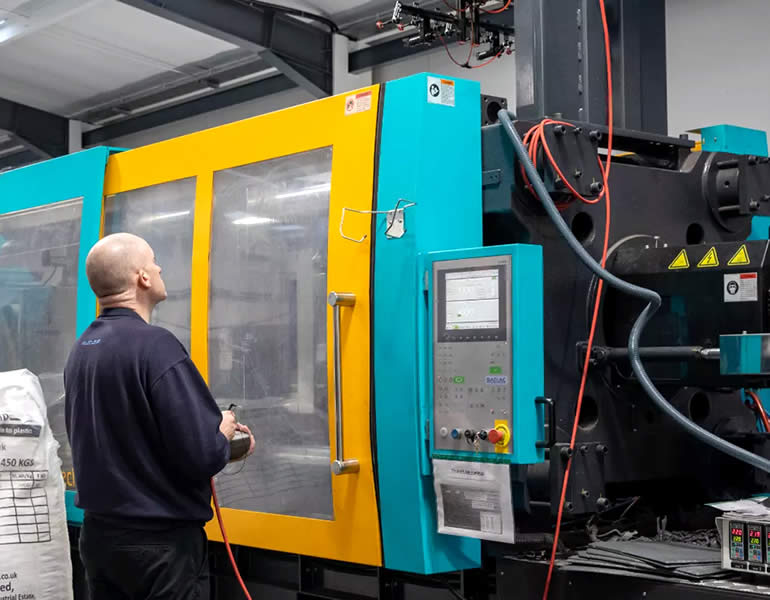
Why Advanced Production Techniques Are Now a Commercial Requirement
In today’s manufacturing environment, competitiveness is no longer driven by capacity alone. It is driven by process intelligence, repeatability, automation and engineering control.
At Stephens Plastic Mouldings, advanced production techniques are not viewed as optional upgrades. They are fundamental to delivering consistent quality, predictable lead times and commercially viable production for our customers across automotive, medical, industrial, electronics and construction sectors.
This article explains how advanced manufacturing techniques directly impact efficiency, scalability, cost control and long-term return on investment—and why manufacturers that fail to adopt them are increasingly exposed to risk.
What Are Advanced Production Techniques?
Advanced production techniques refer to engineered manufacturing systems that combine:
- Automation and process control
- Precision tooling and repeatability
- Data-driven decision making
- Integrated quality systems
- Scalable, high-efficiency workflows
In plastic injection moulding, this means moving beyond manual intervention and reactive problem-solving, toward controlled, optimised and repeatable production environments.
Driving Efficiency Through Precision and Automation
High-Volume Output Without Compromising Quality
Advanced production techniques enable manufacturers to produce large volumes of components with consistent dimensional accuracy and material performance.
At Stephens Plastic Mouldings, this is achieved through:
- Optimised injection moulding cycles
- Repeatable tooling performance
- Controlled material flow and cooling
- Stable processing parameters
The result is high-volume output with minimal variation, even across long production runs.
Automation as a Cost and Risk Reduction Strategy
Automation is not about removing people—it is about removing variability and error.
Automated production systems:
- Reduce manual handling and intervention
- Improve cycle consistency
- Lower scrap and rework rates
- Increase throughput per machine
- Deliver predictable unit costs
For customers, this translates directly into lower total manufacturing cost and improved supply reliability.
Advanced Techniques Enable Product Customisation at Scale
Modern markets demand bespoke, application-specific components rather than generic parts.
Advanced manufacturing techniques allow:
- Faster tooling changeovers
- Material flexibility
- Precision control over part geometry
- Efficient short-run and low-volume production
This enables manufacturers to offer customised solutions without sacrificing efficiency or profitability—a critical advantage in specialist and regulated industries.
Enhancing Product Durability and Performance
Advanced production techniques directly influence how long a product lasts and how it performs in the field.
Through controlled processing and material optimisation, manufacturers can:
- Improve structural integrity
- Reduce internal stresses
- Enhance surface finish and consistency
- Maintain tight tolerances across batches
At Stephens Plastic Mouldings, durability is engineered into the production process—not inspected at the end.
Cost Efficiency Through Waste Reduction and Process Optimisation
Minimising Waste, Maximising Material Value
Precision manufacturing dramatically reduces:
- Material waste
- Start-up scrap
- Defective components
- Energy inefficiencies
By controlling the process at every stage, advanced production techniques support leaner, more sustainable manufacturing models.
Economies of Scale With Predictable ROI
While advanced production systems require upfront investment, they unlock:
- Lower cost per unit at scale
- Greater pricing stability
- Reduced downtime and maintenance
- Stronger long-term margins
For manufacturers focused on ROI rather than short-term savings, advanced techniques are a strategic investment.
Why Advanced Production Techniques Matter in UK Manufacturing
UK manufacturers face unique pressures:
- Rising labour and energy costs
- Tight regulatory requirements
- Demand for traceability and quality assurance
- Shorter lead times and flexible production
Advanced manufacturing techniques allow UK-based production to remain globally competitive while retaining control, quality and responsiveness.
Stephens Plastic Mouldings’ Approach to Advanced Manufacturing
At Stephens Plastic Mouldings, advanced production techniques are embedded across our operation, supported by:
- ISO 9001 certified quality systems
- Automated and optimised injection moulding processes
- Engineering-led design for manufacture (DFM)
- Precision tooling and controlled workflows
- UK-based production and technical oversight
This enables us to deliver reliable, scalable and cost-effective manufacturing outcomes for our customers.
FAQs
1. How do advanced production techniques reduce manufacturing costs?
They reduce scrap, rework, downtime and labour dependency while improving throughput and consistency—lowering total cost per part over time.
2. Are advanced manufacturing techniques suitable for low-volume production?
Yes. Advanced techniques are particularly effective for low-volume and specialist production where precision, repeatability and quality are critical.
3. Do advanced techniques improve product quality in injection moulding?
Absolutely. Controlled processing, automation and precision tooling significantly improve dimensional accuracy, material performance and batch consistency.
4. Why choose a UK manufacturer using advanced production techniques?
UK manufacturers using advanced techniques offer better lead times, tighter quality control, improved communication and reduced supply chain risk.
5. Can Stephens Plastic Mouldings support projects requiring advanced manufacturing?
Yes. We specialise in advanced plastic injection moulding, supporting projects from prototype through to scalable production with full technical oversight.
Final Insight: Advanced Production Techniques Are a Competitive Necessity
Advanced production techniques are no longer about innovation for its own sake. They are about manufacturing resilience, commercial performance and long-term competitiveness.
Manufacturers that invest in precision, automation and process control are better positioned to:
- Control costs
- Protect quality
- Scale efficiently
- Meet future market demands
At Stephens Plastic Mouldings, advanced manufacturing is not a trend—it is the foundation of how we deliver results.
Call to Action
If you are evaluating advanced production techniques for plastic injection moulding or want to improve efficiency, quality and ROI within your existing manufacturing strategy, expert input at this stage can significantly reduce risk and cost.
Contact Stephens Plastic Mouldings to discuss how advanced manufacturing techniques can support your project and request a tailored quotation.