



Why Material Choice Matters in Injection Moulding
At Stephens Plastic Mouldings, we believe the success of every moulded component starts with selecting the right plastic. The thermoplastic used in a part determines its strength, finish, chemical resistance, weight, cost-and ultimately, its market performance.
In this guide, we’ve outlined the most effective materials for plastic injection moulding in 2025, based on our experience delivering precision moulded parts to the automotive, medical, packaging, and electronics sectors across the UK.
What Are Thermoplastics?
Thermoplastics (also known as thermosoftening plastics) soften when heated and harden once cooled. Unlike thermoset plastics, they can be reshaped and recycled repeatedly without significant degradation – making them ideal for mass production, complex geometries, and sustainable manufacturing practices.
To learn how this process works, see our plastic injection moulding process guide.
Top Thermoplastics for Injection Moulding in 2025
1. Acrylic (PMMA)
Commonly branded as Plexiglas or Perspex, acrylic is lightweight, transparent, and visually striking. It’s perfect for:
- Consumer packaging.
- Display units.
- Medical lenses.
- Cosmetic housings.
Its high clarity and impact resistance make it a cost-effective glass alternative.
2. Polyester
An industrial-grade polymer used for:
- Textile-reinforced components.
- Automotive parts.
- High-load mechanical assemblies.
Polyester is chemically resistant, dimensionally stable, and ideal for high-heat environments.
3. ABS (Acrylonitrile Butadiene Styrene)
ABS combines affordability, toughness, and ease of moulding. It’s widely used for:
- Automotive interiors.
- Electronic casings.
- Tool housings.
This versatile plastic is a great fit when surface finish and strength are equally important.
Dive deeper in our automotive injection moulding guide.
4. Polypropylene (PP)
Lightweight and chemically inert, PP is one of the most popular materials globally. Common applications:
- Packaging.
- Medical devices.
- Food-grade containers.
It resists moisture, acids, and fatigue, making it ideal for high-cycle or flexible parts.
5. Polystyrene (PS)
Used for:
- Smoke detector housings.
- Disposable utensils.
- Packing inserts.
While less durable than ABS, it’s economical and easy to mould – ideal for low-cost or temporary components.
6. Nylon (PA)
A high-performance engineering plastic offering:
- Excellent mechanical strength.
- High temperature resistance.
- Low friction.
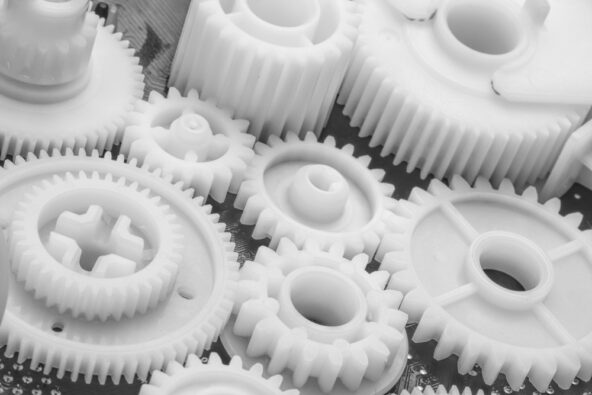
Used in gears, connectors, and under-the-hood components in automotive and industrial sectors.
Explore our engineering thermoplastics page for more advanced options.
7. Teflon (PTFE)
Teflon is perfect for parts requiring:
- Low friction.
- Chemical resistance.
- High operating temperatures.
Applications include: seals, bushings, medical valves, and cookwear – safe parts.
Choosing the Right Material for Your Project
We don’t just offer plastic injection moulding – we provide expert material consultation. Every project we deliver begins with a DFM (Design for Manufacture) review, where we help you:
- Select the most suitable plastic.
- Reduce tooling complexity.
- Optimise wall thickness, tolerances, and cycle time.
Visit our plastic injection moulding services page to learn more.
FAQs
1. What is the most commonly used plastic for injection moulding?
Polypropylene and ABS are two of the most widely used due to their cost-effectiveness, mouldability, and strength. We recommend based on your specific performance requirements.
2. Can Stephens Plastic help me select the right plastic for my part?
Yes. We offer free consultations and trial tooling to test material suitability for strength, flexibility, thermal resistance, and compliance needs.
3. Do you supply food-safe or medical-grade plastics?
Absolutely. We source certified FDA- and EU-compliant plastics, with full batch traceability, ideal for food containers and sterile packaging.
4. What’s the difference between thermoplastics and thermosets?
Thermoplastics can be reheated and remoulded, making them recyclable and more suitable for mass production. Thermosets cure permanently and are typically used in high-heat, structural settings.
5. What’s your minimum volume for material-specific projects?
We can support low-volume production (starting from hundreds of units) through to mass production – with flexible material sourcing and short lead times.
Ready to Specify Your Thermoplastic?
Stephens Plastic Mouldings offers competitive pricing, ISO 9001-certified manufacturing, and expert material selection support across every project.
Let’s make sure you mould it right – from material to market.
Contact Stephens Plastics Today
Email: sales@stephensplasticmouldings.co.uk
Phone: 0121 544 5808